


Launching Payload Using Electromagnetism
- Mar 15, 2019
- 2 min read

Known as the "Lunar Mass Driver", the concept of accelerating payload using an electromagnetic tube has been around since the 1960's. The idea is simple;
.
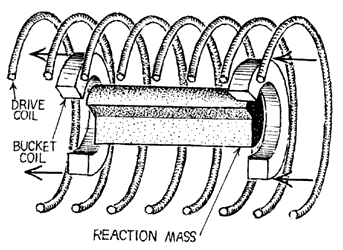
Harvested lunar material, possibly helium-3 or REE (Rare Earth Elements) are stored and put into cylindrical containers. These containers then put into the electromagnetic tubes and the payload starts to accelerate. The length of this tube depends on the efficiency and the power of the given energy.
.
Once the payload reaches the escape velocity of the moon, which is only 2.4 kilometers (1.5 miles) per second, the cargo will be deployed into the Lunar orbit. Because of the lack of atmosphere, the payload keeps its momentum. From there, It can be harvested by another cargo vehicle and be transported back to earth safely. Or, to increase operational efficiency, velocity can be increased and the cargo can be aimed for the Earth directly. After the launch, tubes can be recharged and used again relatively shortly. This allows rapid smaller scale operations compared to one massive rocket launch at the fraction of the cost per launch.
.
This method of electromagnetic acceleration has been used in US Navy carriers for years. New railgun technology also relies on the same concept and technology.
Mass Drivers for Earth?
Previous proposals to use this concept here on Earth however seems more difficult because of Earths higher escape velocity of 7.8 kilometers (4.8 miles) per second, strong gravitational pull and surrounding atmosphere which creates additional drag.
.
The concept and technology looks promising. Once we settle on our Lunar body and start harvesting its ore, this method of transportation may provide a bridge between Earth and Moon itself.
Further Studies/Formulas;
Escape velocity:
V = SQRT( 2 * Mu / R )
Mass driver tube length:
S = V2 / ( 2 * a )
For a Brief explanotary for mass drivers, click "Here".
Comments